Pulmonary Medical Billing & Coding Resource

Your comprehensive guide for pulmonary medical billing resources, coding guides, and revenue cycle management tips. Designed for pulmonologists, practice managers, and billing staff seeking clarity, compliance, and higher reimbursements.

Content:

  • Most Common CPT & ICD-10 Codes for Pulmonary Medicine
  • Key Billing Challenges & Compliance Notes
  • Tips for Maximizing Collections & Reducing Denials
  • Tips for Maximizing Collections & Reducing Denials
  • Frequently Asked Questions (FAQs)
  • How ClaiMed Solutions Can Help
Pulmonologists and billing staff reviewing digital pulmonary billing resources in a bright office.

Most Common CPT & ICD-10 Codes for Pulmonary

CPT Code

Description

Common Use

94010

Spirometry, including graphic record

Lung function testing

94640

Nebulizer treatment

Breathing treatment

94660

CPAP ventilation initiation

Sleep apnea/respiratory care

94760

Pulse oximetry, single determination

Oxygen saturation check

99214

Office visit, established patient

Follow-up evaluation

ICD-10 Code

Description

Common Use

J44.9

Chronic obstructive pulmonary disease, unspecified

COPD diagnosis

J45.909

Unspecified asthma, uncomplicated

Asthma diagnosis

R06.02

Shortness of breath

Symptom documentation

J18.9

Pneumonia, unspecified organism

Pneumonia diagnosis

Z87.891

Personal history of nicotine dependence

Smoking history

Note: Codes and descriptions should be verified with payers and updated annually.

Key Billing Challenges & Compliance Notes
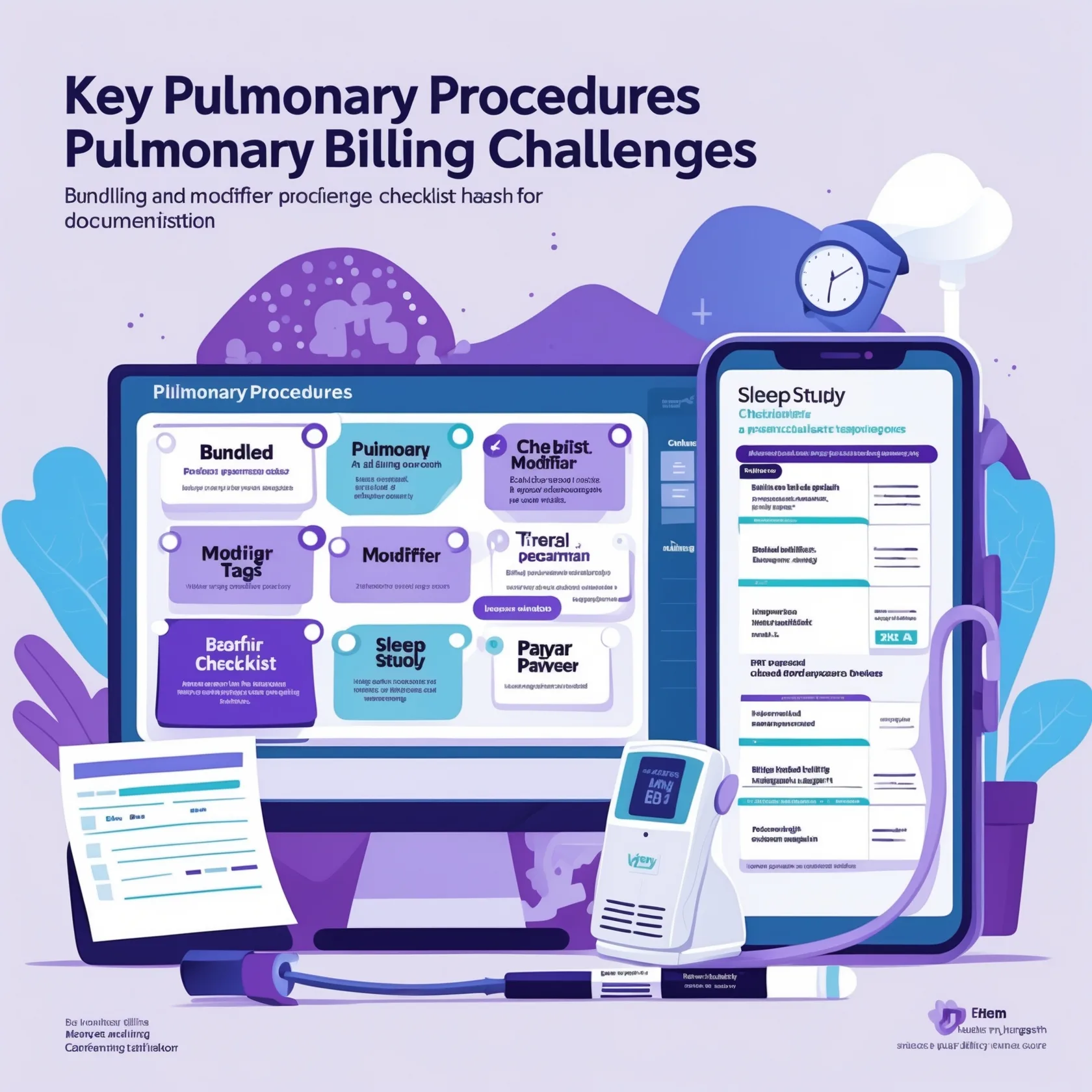
  • Bundling of pulmonary procedures (e.g., spirometry with other tests)
  • Modifier use for multiple services (e.g., -25, -59)
  • Documentation for medical necessity (especially for repeat tests)
  • Prior authorization for sleep studies and advanced pulmonary procedures
  • Payer-specific rules for chronic care management
Illustration of pulmonary billing challenges with bundled procedures, modifiers, and documentation checklist.
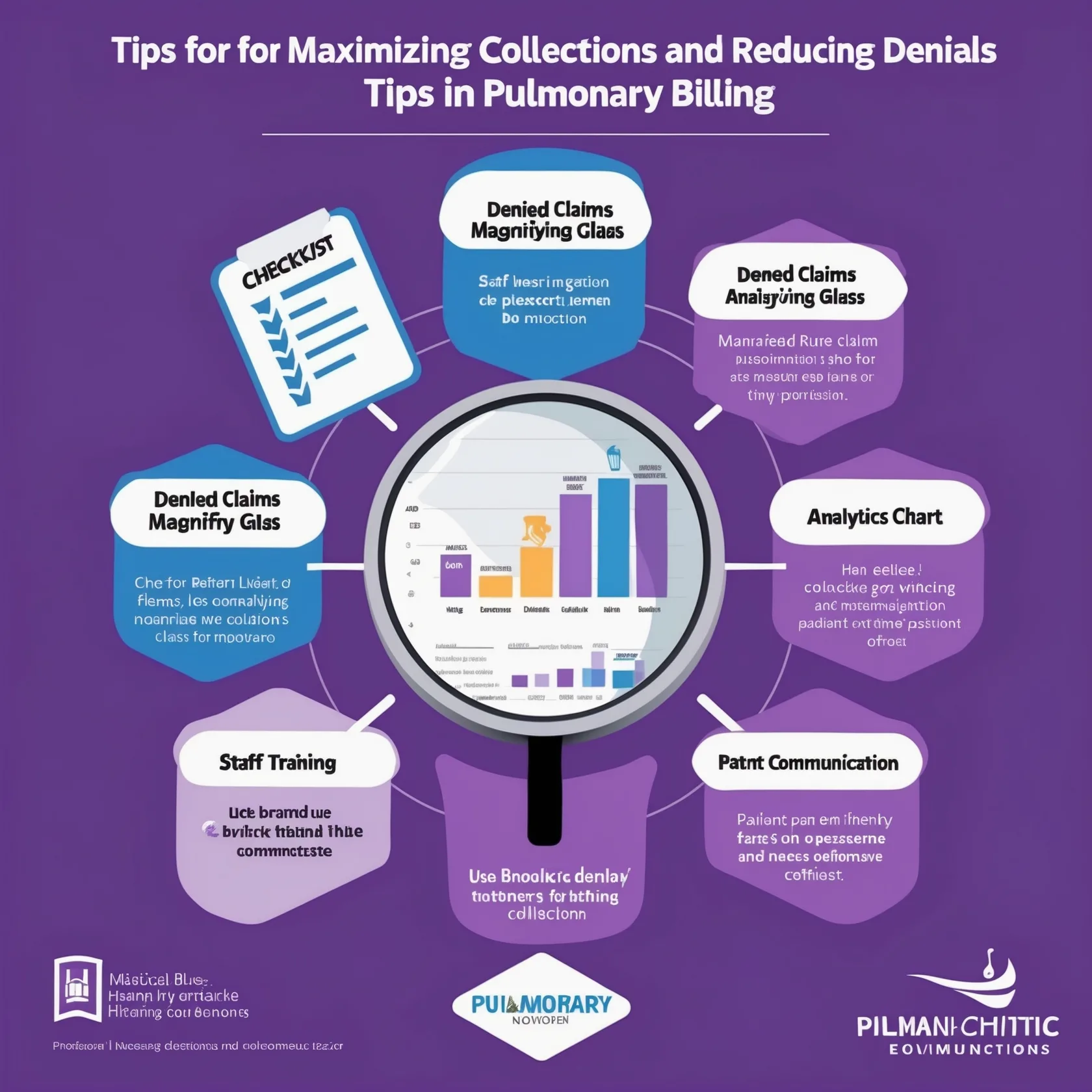
Infographic with tips for maximizing pulmonary collections and reducing denials.

Tips for Maximizing Collections & Reducing Denials

  1. Review payer-specific pulmonary coding guidelines regularly
  2. Audit denied claims monthly for patterns and training needs
  3. Use AdvancedMD analytics to track collections and claim status
  4. Train staff on documentation for repeat and bundled services
  5. Communicate with patients about insurance coverage and co-pays

Frequently Asked Questions

Yes, often you can, but it depends on payer rules and documentation.

  • If the office visit (E/M) is significant and separately identifiable from the spirometry (e.g., complex evaluation, medication changes, comorbid management), you typically:
    • Bill the E/M code (e.g., 99213/99214)
    • Bill spirometry (e.g., 94010)
    • Add modifier -25 to the E/M code to show it is a separate service.
  • If the visit is primarily for performing spirometry with minimal additional evaluation, many payers expect only the procedure to be billed.
  • Always check payer policies and ensure your note clearly supports both services.

Common pulmonary-related modifiers include:

  • Common pulmonary-related modifiers include:
  • -25: Significant, separately identifiable E/M service on the same day as a procedure (e.g., office visit + spirometry or nebulizer treatment).
  • -59 (or payer-specific subset modifiers like XE, XS, XP, XU): Distinct procedural service when multiple procedures might otherwise be bundled.
  • -76 / -77: Repeat procedure by same or different physician (for repeat tests in the same day when justified).
  • -RT / -LT: Right/left, if applicable for certain procedures or imaging.

Use modifiers only when documentation clearly supports a distinct service and when allowed by the payer’s bundling rules.

For repeat PFTs or spirometry, your documentation should answer “why again?”:

  • Clearly describe:
    • Change in symptoms (e.g., worsening dyspnea, new wheeze, change in exercise tolerance).
    • Change in clinical status (exacerbation of COPD/asthma, post-hospital follow-up, pre-op evaluation).
    • Treatment decisions that depend on the results (e.g., escalating therapy, assessing response to new inhaler, determining need for oxygen).
  • Link the test to an appropriate ICD-10 diagnosis (e.g., J44.9, J45.909, R06.02).
  • If payer policies specify intervals (e.g., not more often than every X months unless change in status), explicitly document the reason for earlier testing.

Requirements vary by payer, but generally include:

  • Documented clinical indications:
    • Symptoms such as loud snoring, witnessed apneas, excessive daytime sleepiness, resistant hypertension, etc.
  • Appropriate diagnosis codes (e.g., suspected sleep apnea, snoring, hypersomnia).
  • Prior authorization:
    • Many payers require pre-approval for in-lab polysomnography and some home sleep tests.
    • Authorization number should be documented and included on the claim.
  • Correct CPT code selection:
    • Different codes for in-lab vs. home studies, with/without technician, split-night vs. full-night, etc.
  • Technical and interpretation components:
    • If billing only professional interpretation or only technical component, use modifiers -26 or -TC as required.

Always follow payer-specific clinical criteria and documentation checklists for sleep studies

A strong appeal is specific, supported, and payer-aligned:

  1. Identify the denial reason
    • Review the EOB/ERA for the exact denial code and description (e.g., lack of medical necessity, missing prior auth, bundled service).
  2. Correct any technical errors
    • Verify patient demographics, NPI, modifiers, and CPT/ICD-10 codes.
  3. Attach supporting documentation
    • Office notes, test results, prior authorization approval, and any relevant policy excerpts.
    • Highlight the portions that support medical necessity or distinct services.
  4. Reference payer policy
    • When possible, cite specific sections of the payer’s medical policy or LCD/NCD that support the service.
  5. Resubmit within timelines
    • Follow the payer’s appeal process and deadlines exactly (first-level, second-level, etc.).

Over time, track denial patterns (e.g., repeat issues with spirometry, nebulizer treatments, or sleep studies) and adjust front-end workflows and documentation training to prevent them.

Ready to simplify your Orthopedic billing and boost your revenue?

Book a free consultation with our mental health billing specialists today.

ClaiMed Solutions

5900 Balcones Dr. #18440 Austin, TX 78731
Phone: 800-420-4915
Email: info@claimedsolutions.com

ClaiMed Solutions Billing software: